Noon Repose Pavilion
▲ Figure 1 Noon Repose Pavilion Aerial perspective ©Arch-Exist
Location Huizhou city, Guangdong Province
Area 350㎡
Genre Public Space
The Noon Repose Pavilion is located on the bank of a rural river in Huizhou, a city in southern China, along the scenic route encircling Nankun Mountain and Luofu Mountain. Huizhou was once a place of exile for the Northern Song scholar Su Shi. During his years there, exile did not result in withdrawal from life, but rather intensified his attention to its everyday rhythms. In his writings, he identified what he called the “sixteen pleasures of life,” one of which he described as “resting at noon on a simple rattan pillow.”
The pavilion takes its name from this phrase. It is not intended as a nostalgic reference, but as a way of anchoring contemporary experience to a different understanding of time—one that allows for pause, slackening, and repose. What is recalled here is not a historical figure, but a mode of living that remains possible in the present.
Background
▲ Figure 2 Noon Repose Pavilion floor plan ©CLAB
Site: An Enclave and the State of Noon
The site of the Noon Repose Pavilion is, in a literal sense, a place that had been abandoned. A decade earlier, it had served as a temporary construction camp for a nearby real estate development. After the structures were dismantled, the land was left unused. Traces of human intervention remained, but were gradually overtaken by the rapid growth of shrubs, vines, and spontaneous vegetation typical of the humid southern climate. A new order emerged atop the remnants of the old.
It is precisely this condition of abandonment that gives the site its distinct atmosphere. Neither cultivated nature nor continuously maintained urban ground, it exists in an ambiguous state between the two. Accessed through a modest opening along a national highway, the site contrasts sharply with the uniform commercial buildings that line the road. Here, wild vegetation intertwines with residual artificial traces, producing a space that feels unfamiliar yet alive.
This spatial condition resonates with the temporal state suggested by “noon Repose.” The fatigue of midday is not the opposite of productivity, but a suspended moment within the modern rhythm of efficiency—a time that does not serve an outcome, yet persists within everyday life. The pavilion responds to this overlooked interval.
▲ Figure 3 Noon Repose Pavilion Inner courtyard perspective ©Arch-Exist
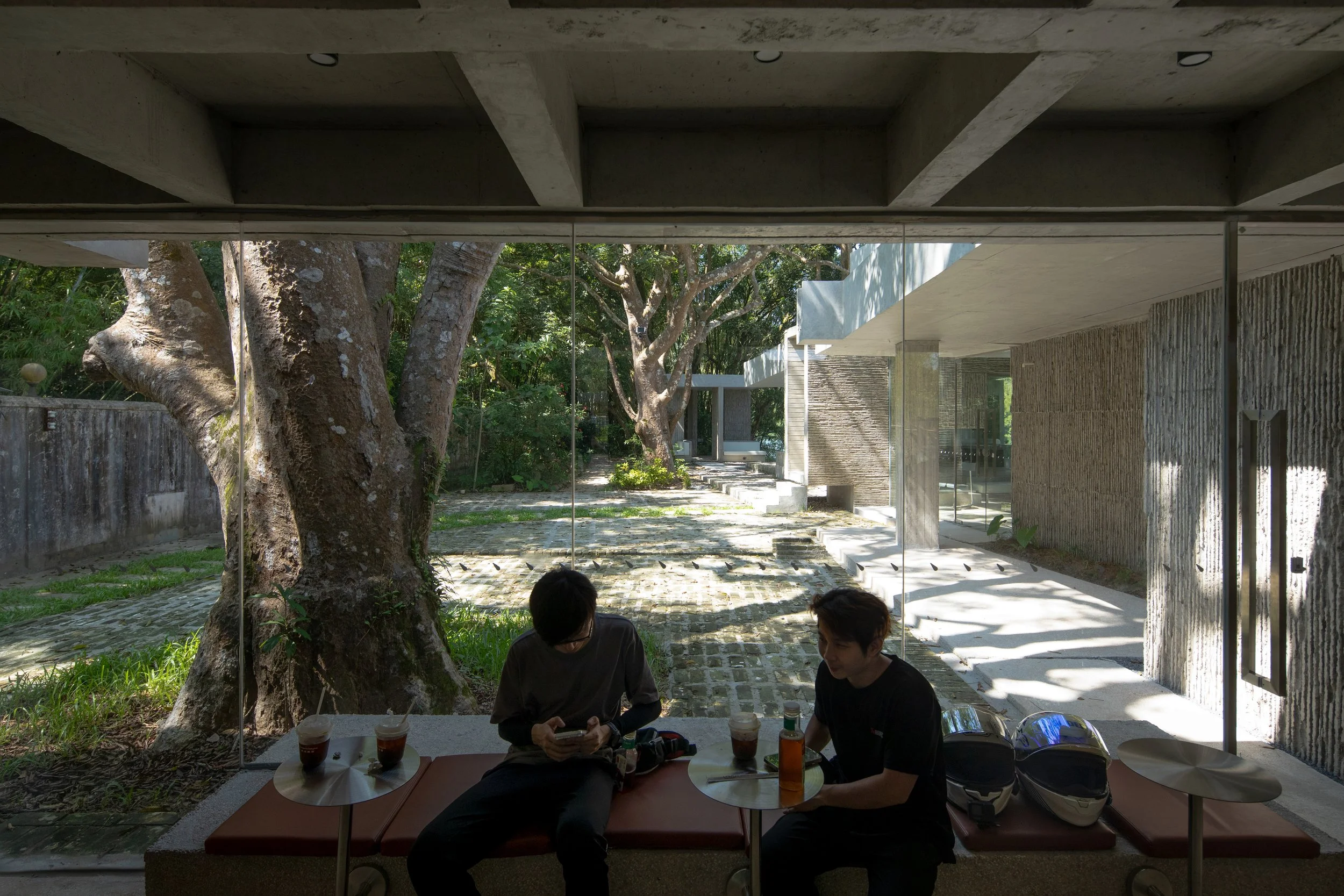
Programmatically, the Noon Repose Pavilion is not a building defined by strong functional imperatives. It operates first as a landscape condition, where a narrative path unfolds and partial climatic boundaries are established for occupation. Within these boundaries are a small café and a dessert station for afternoon tea. These functions do not seek to generate novelty, but gently align themselves with the slow tempo of the afternoon.
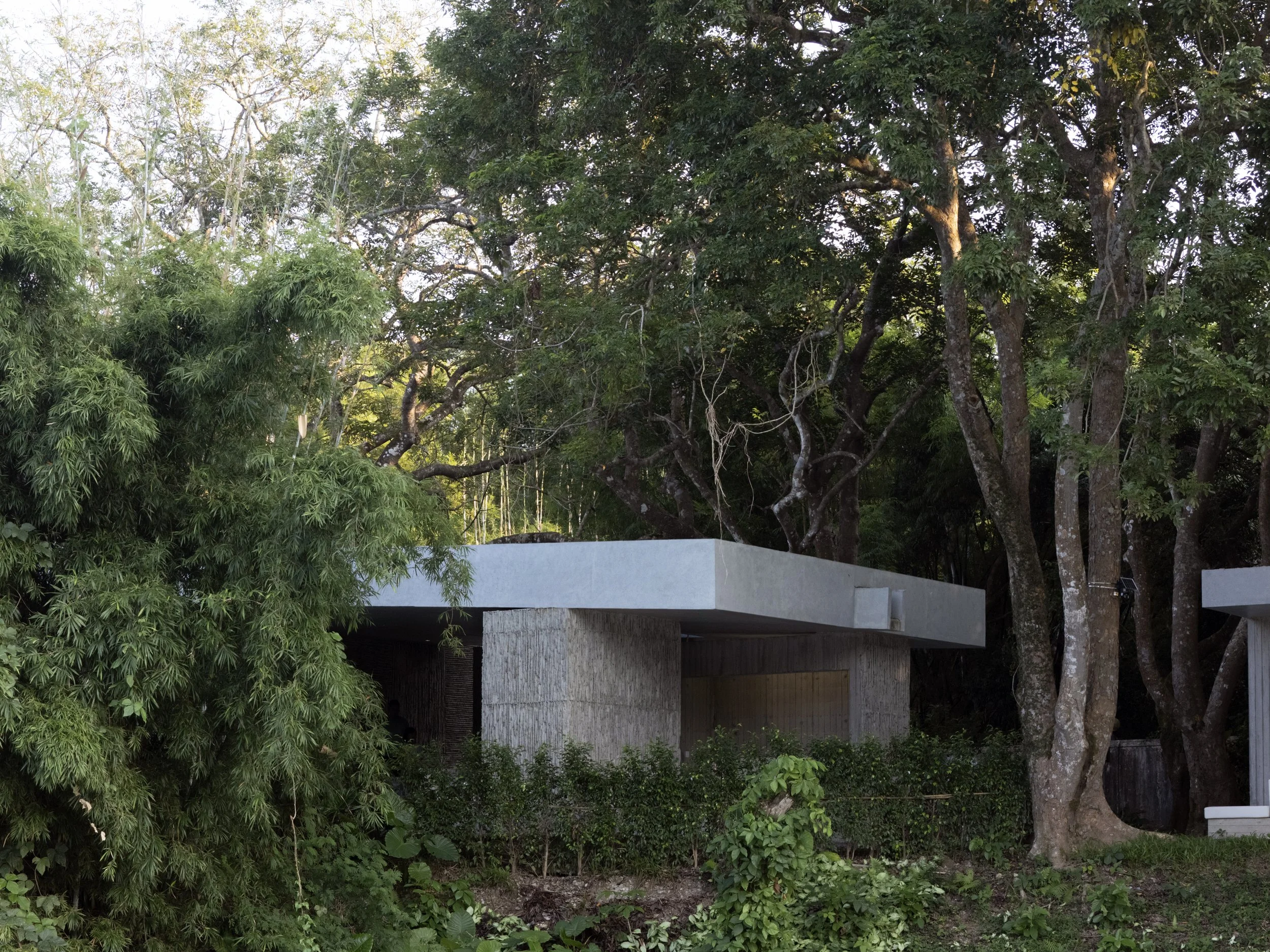
Formally, the site is shaped foremost by twelve mature trees, one of which is over a century old. Their trunks establish a vertical order within the site, while their canopies almost entirely cover it, producing an enclosed space with a primordial sense of shelter. Rather than resisting this natural dominance, the architecture develops in response to it.
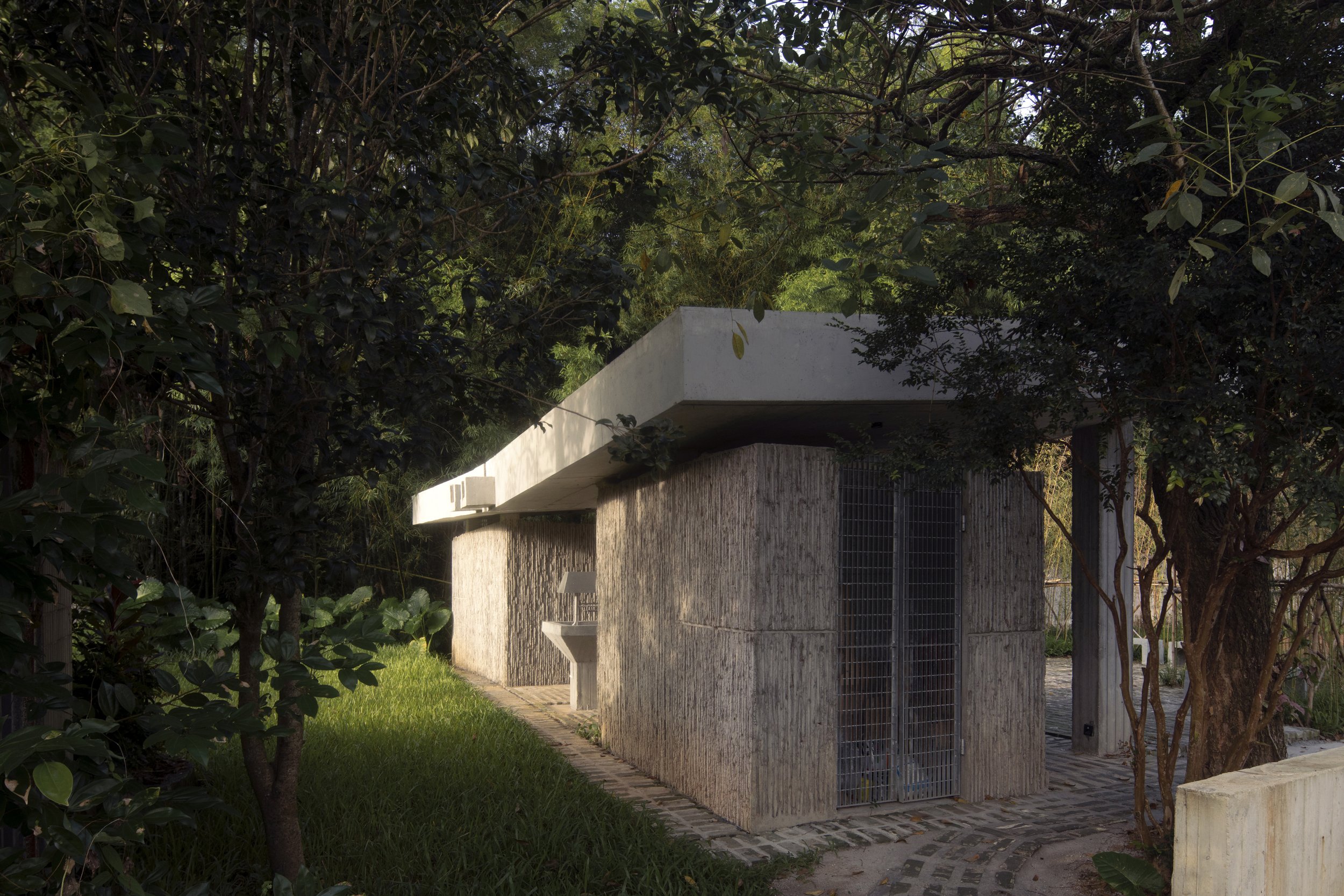
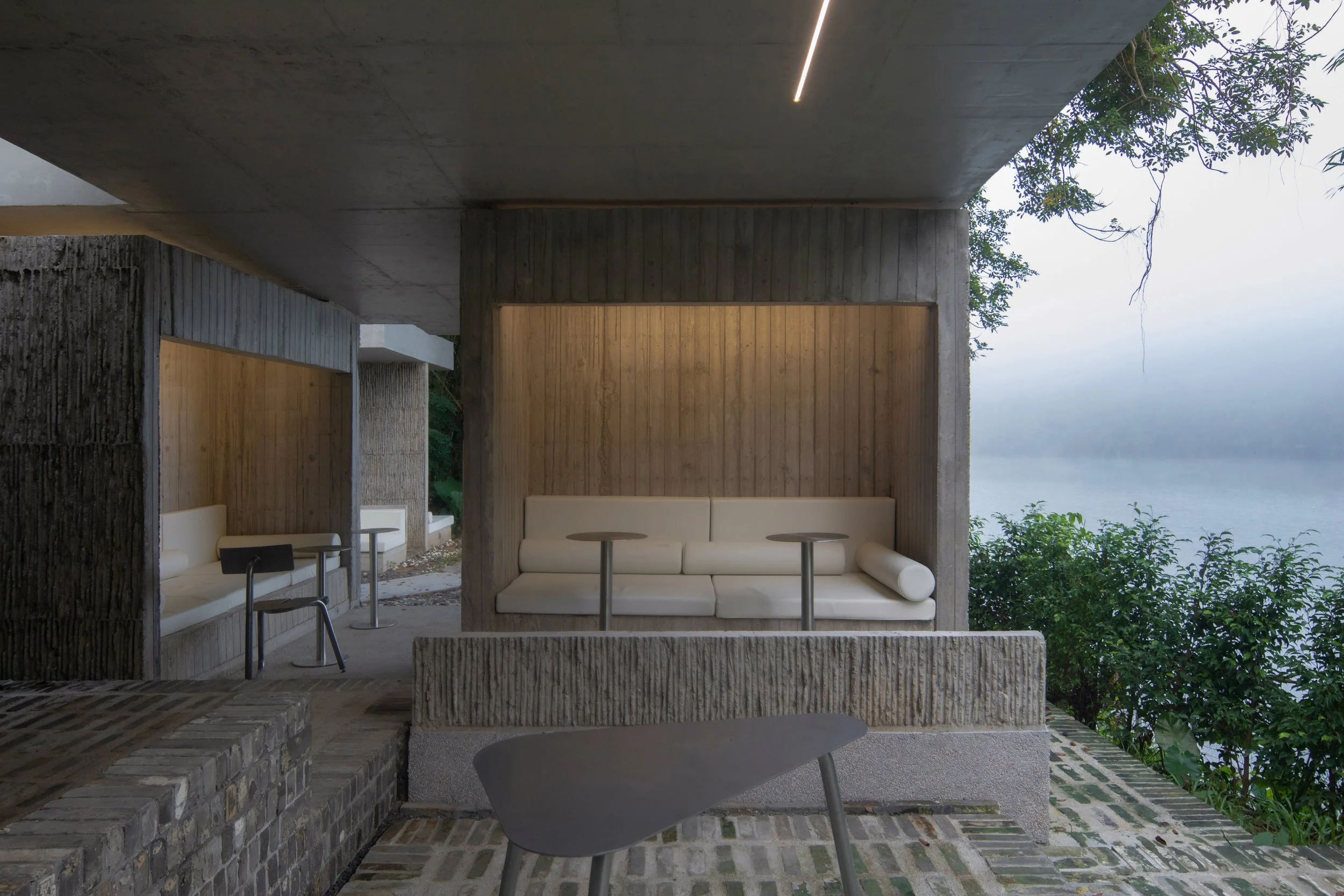
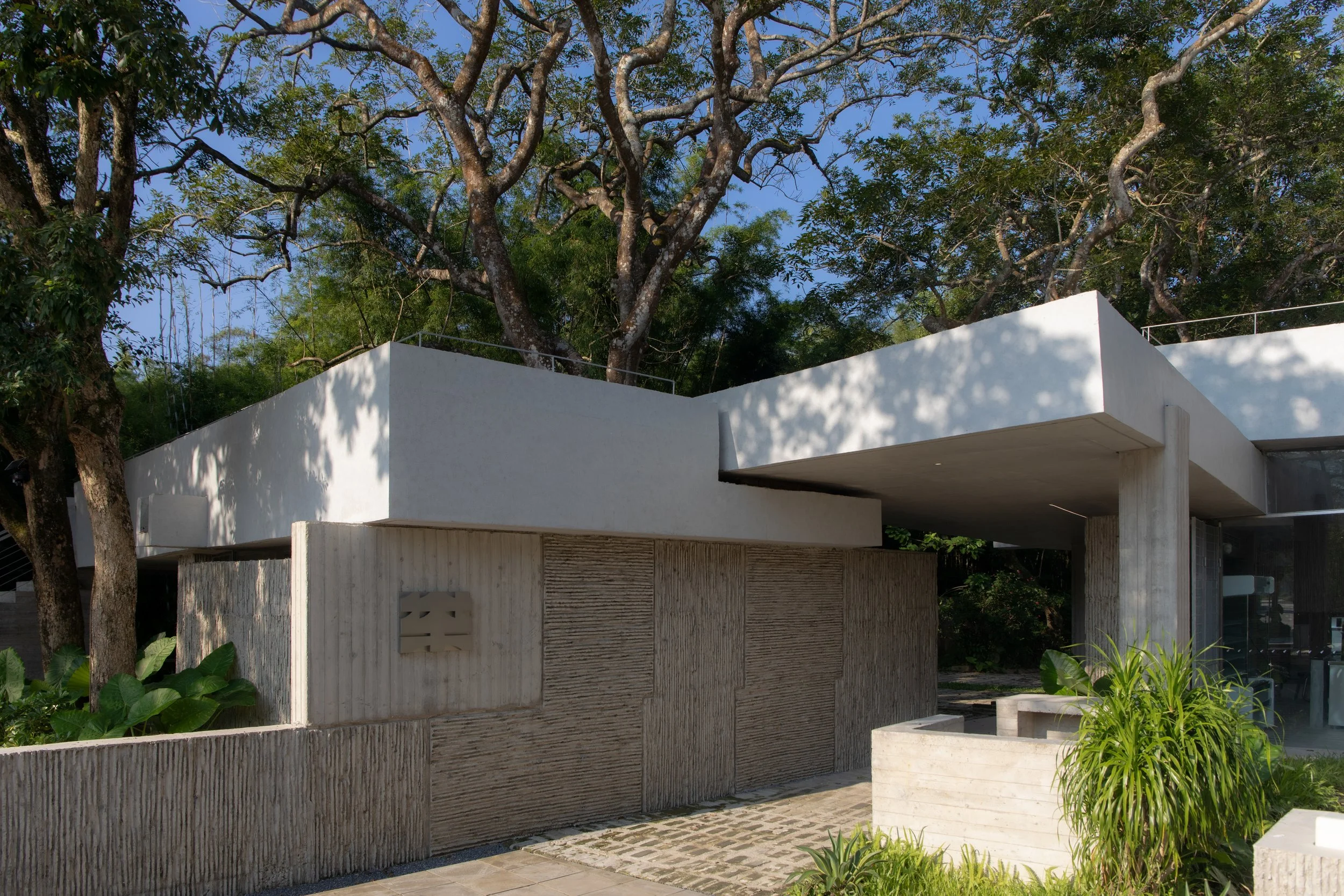
The pavilion is composed of a series of continuous, interlocking stone-like volumes. Together with the tree trunks, they create a spatial sequence that invites movement and pause. The entrance is marked by a stone gate that clearly separates inside from outside. Beyond it, a narrow passage defined by bamboo and low walls constrains the field of vision, compressing the spatial experience. At the end of the path, a partially enclosed, cave-like space formed by stone slabs opens up as the core of the pavilion. Massive tree trunks and concrete blocks define a semi-outdoor resting area; the blocks also function as wide sleeping alcoves. Glass enclosures inserted between certain volumes establish controlled climatic zones, their transparency and reflection alternating with movement, producing a secondary, immaterial layer of space among trees and stones.
Program and Form
▲ Figure 4 Noon Repose Pavilion entrance Bird's-eye view ©Arch-Exist
The stone assemblages of the Noon Repose Pavilion are constructed in concrete, yet they are conceived as being assembled rather than cast. Although concrete must, in technical terms, be poured, casting tends to collapse form and meaning into a single, irreversible gesture. Assembly, by contrast, acknowledges that materials possess their own latent order, and that construction is a process of allowing this order to appear.
The roof consists of four independent rectangular concrete slabs. Rather than resting horizontally atop the walls, each slab is inclined by approximately five percent in a different direction. This subtle adjustment produces varying heights at the junctions between walls and roof, so that each vertical element touches the slab at only one corner, while the opposite corner separates naturally. The resulting wedge-shaped gaps emphasize the independence of wall and roof as distinct entities, reinforcing the image of stones placed in relation to one another, rather than fused into a single mass.
Assembled Stones
▲ Photo of the construction site*3 ©CLAB
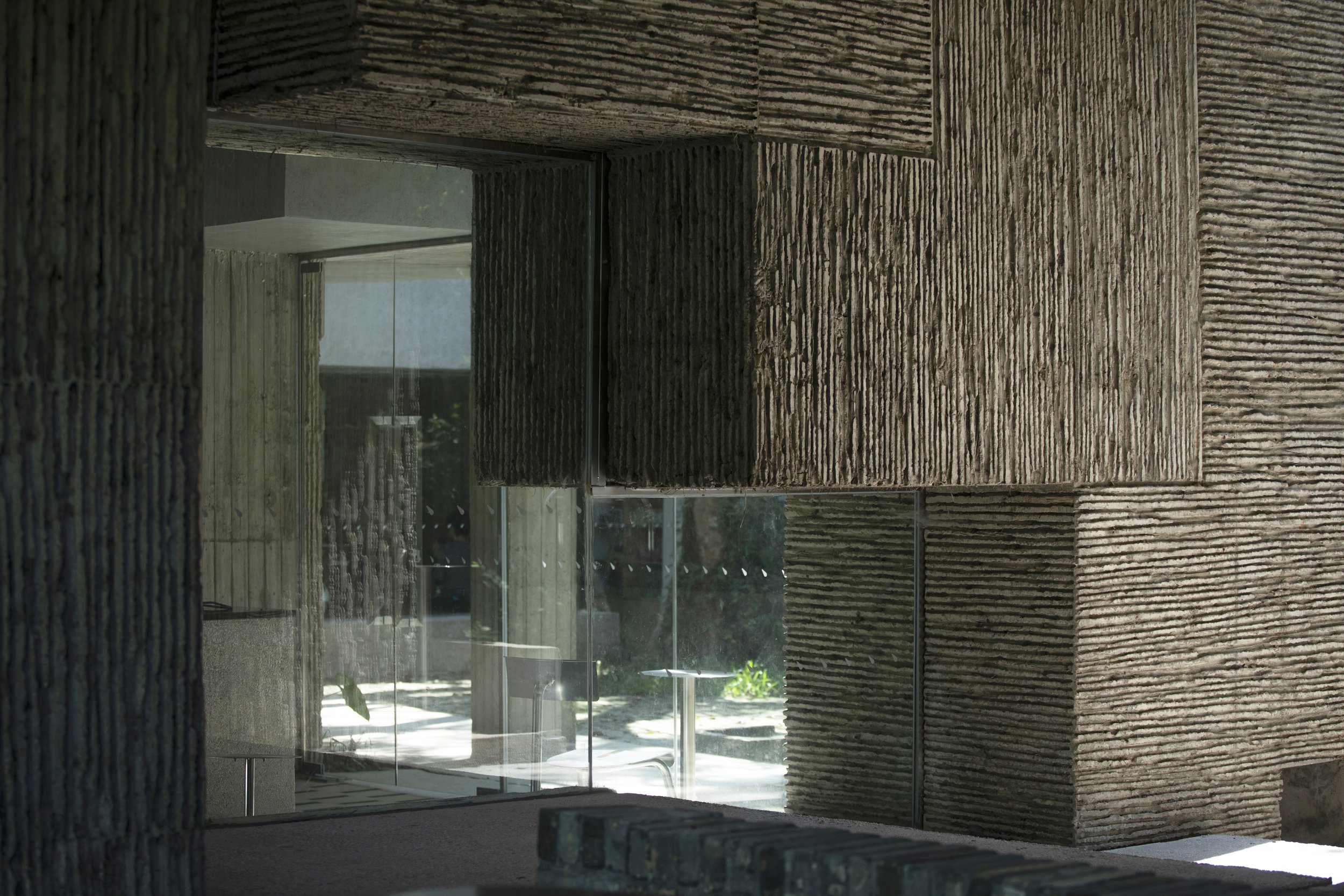
The exposed concrete walls of the pavilion do not derive their surface from standardized formwork, but from a process that unfolds during construction itself. Corn stalks left over after the annual harvest in northern China were fixed onto wooden panels and used as formwork. When the concrete reached its initial set and the panels were removed, the fibers, joints, and growth patterns of the stalks remained embedded in the surface as permanent traces. These marks were not designed in advance; they are the direct residue of construction.
In this process, building ceases to be the execution of a predetermined form. Corn stalks resist geometric discipline: they bend, fracture, and vary in thickness, compelling the builder to slow down and continually adjust. Handcraft here is not opposed to efficiency; it is the condition that allows construction to take place at all. Through bodily engagement, the material’s own order is permitted to emerge rather than being suppressed.
This mode of construction resonates with the presence of vegetation on the site. The pavilion does not stand on cleared ground, but within an environment continuously shaped by trees, shrubs, and spontaneous growth. The corn stalks—discarded remnants of a plant’s life cycle—become mediators in the making of concrete, allowing vegetal form to enter the wall as a negative imprint. Concrete thus ceases to be merely an inert material oriented toward permanence; it becomes a carrier of temporal difference, preserving traces of life that was once present.
Construction: Handcraft
Corn-stalk formwork cannot be precisely replicated or fully predicted. Its use demands patience, repetition, and coordination. Construction becomes a duration that is lived through, rather than a result to be delivered. It is through these faithfully retained traces of making that the building exceeds its status as a finished object, becoming instead a persistent reference to construction itself—a record of how, in a specific place, human beings entered into a relationship with the world through slow, finite, and irreducible acts.
▲ Figure 5 Noon Repose Pavilion Staircase facade texture ©Arch-Exist
▲ Figure 6 Noon Repose Pavilion interior View ©Arch-Exist
▲ Figure 7 Noon Repose Pavilion Section drawing ©CLAB