CLAB RAW Office
Location Chengdu city, Sichuan Province
Area 120㎡
Genre Office Space
01. Micro-Urban Renewal in Yulin
The “urban renewal” of Yulin seems to have emerged even before the topic gained traction in policy and architectural discourse in recent years. One of the key driving forces behind this process undoubtedly lies in the unique urban fabric of Yulin, which fosters a distinctive everyday vitality.
Unlike top-down renewal models, a large number of young entrepreneurs have gradually moved into the area, operating bookstores, cafés, new dining venues, and various lifestyle-oriented commercial spaces. Meanwhile, the government has supported this transformation through façade renovations of older buildings. Together, these forces have initiated a bottom-up mode of urban regeneration. As renewal progresses, the area continues to attract small and micro-scale businesses, forming a positive feedback loop.
This bottom-up approach implies a latent proposition: functional renewal takes precedence over formal renewal. Thus, at the end of 2023, when CLAB Architects relocated to Yulin and faced the task of transforming an aging apartment into a new office, we adopted a similar attitude—to construct function rather than decorate interiors. The project is therefore regarded as a micro-scale experiment in urban renewal at its smallest unit.
The new office is located on the fourth floor of an old residential compound built around 2000. The complex has an L-shaped layout: the two ends consist of a frame structure at the base with brick-concrete construction above, while the corner connection adopts a full-frame system—offering greater flexibility for transformation.
The office itself is a deep rectangular plan with daylight from three sides. Based on the spatial sequence from the entrance, we divided it into two juxtaposed zones:
a smaller, square space near the entrance for public functions (exhibition, meetings),
and a larger, better-lit square space deeper inside for internal office use.
Service spaces requiring plumbing—such as the restroom and pantry—remain aligned with the original vertical shafts of the bathroom and kitchen. These are defined by cast-in-place concrete volumes, which both articulate spatial divisions and address water-related functional requirements.
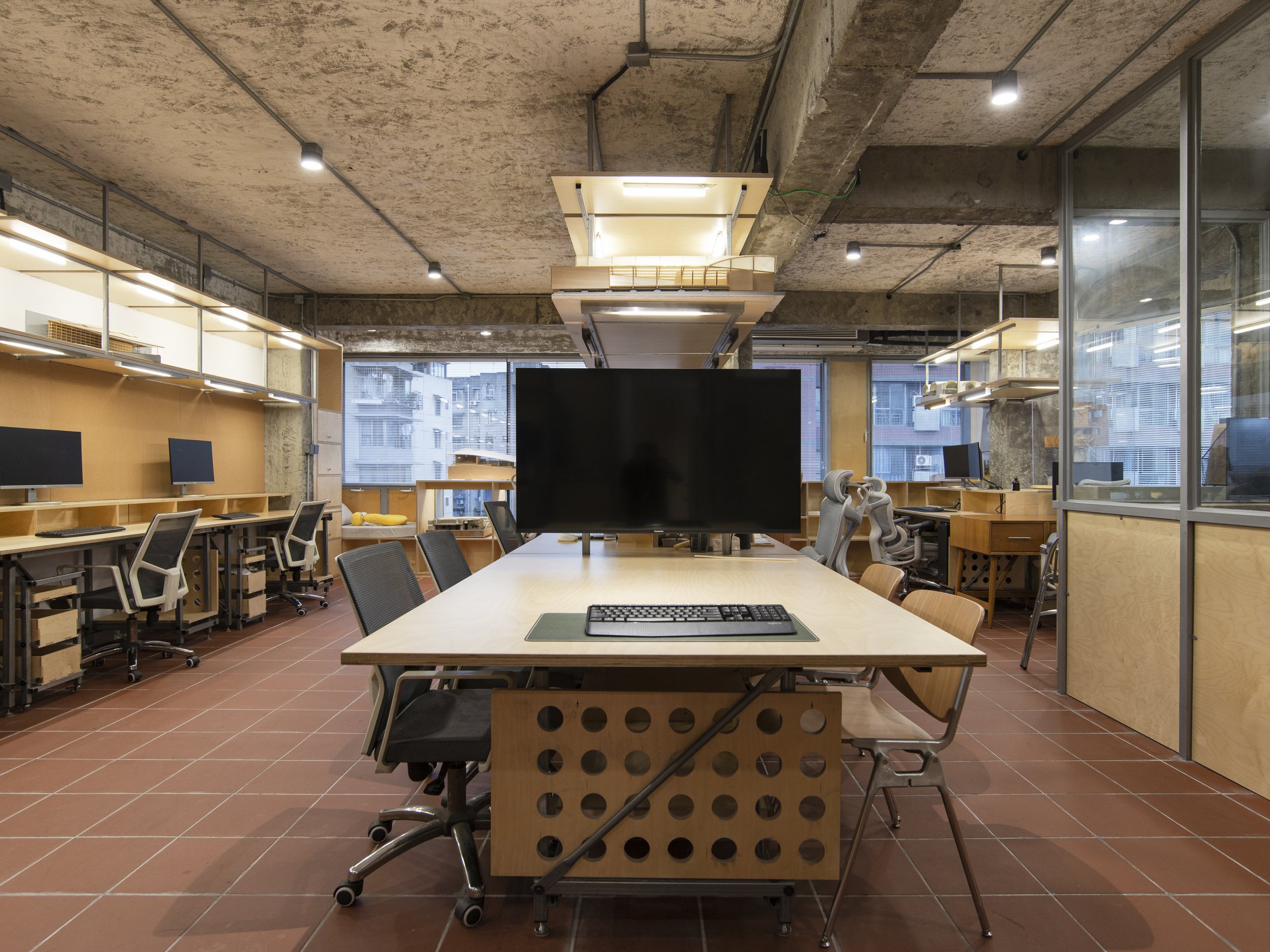
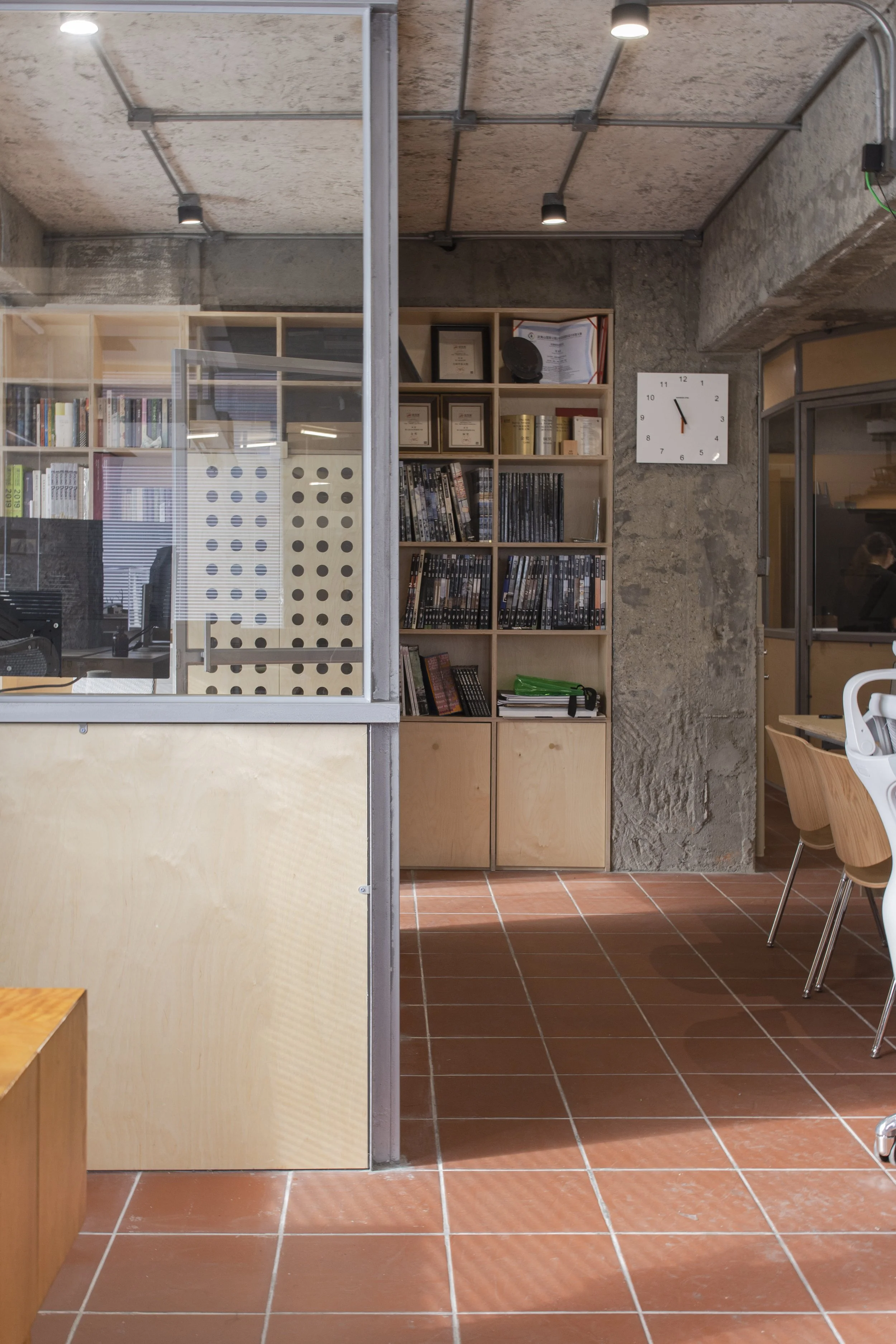
In the office area, workstations are arranged in a loop configuration. Along the south-facing windows, bookshelves and lounge seating are installed, allowing the best-lit area to become a shared space.
02. RAW: Construction as Architecture
“Construction is Architecture” is the guiding principle of CLAB. In building our new office, we sought to directly embody this idea: from construction to use, construction becomes function, and construction becomes architecture.
Three principles were established at the outset:
Only commonly used construction materials—concrete, steel, and wood—are employed, in their raw and primary states.Simple and direct structural systems express use—eliminating decoration so that structure itself conveys aesthetics and responds to function.
Structural joints are manually assembled. All furniture is designed and built by ourselves, requiring consideration of non-professional construction feasibility, so that making becomes part of daily work and life.
We named the office RAW Office. “Raw” signifies origin and essence. RAW Office uses raw materials, direct physical labor, and unadorned structural forms to realize straightforward functional use through construction.
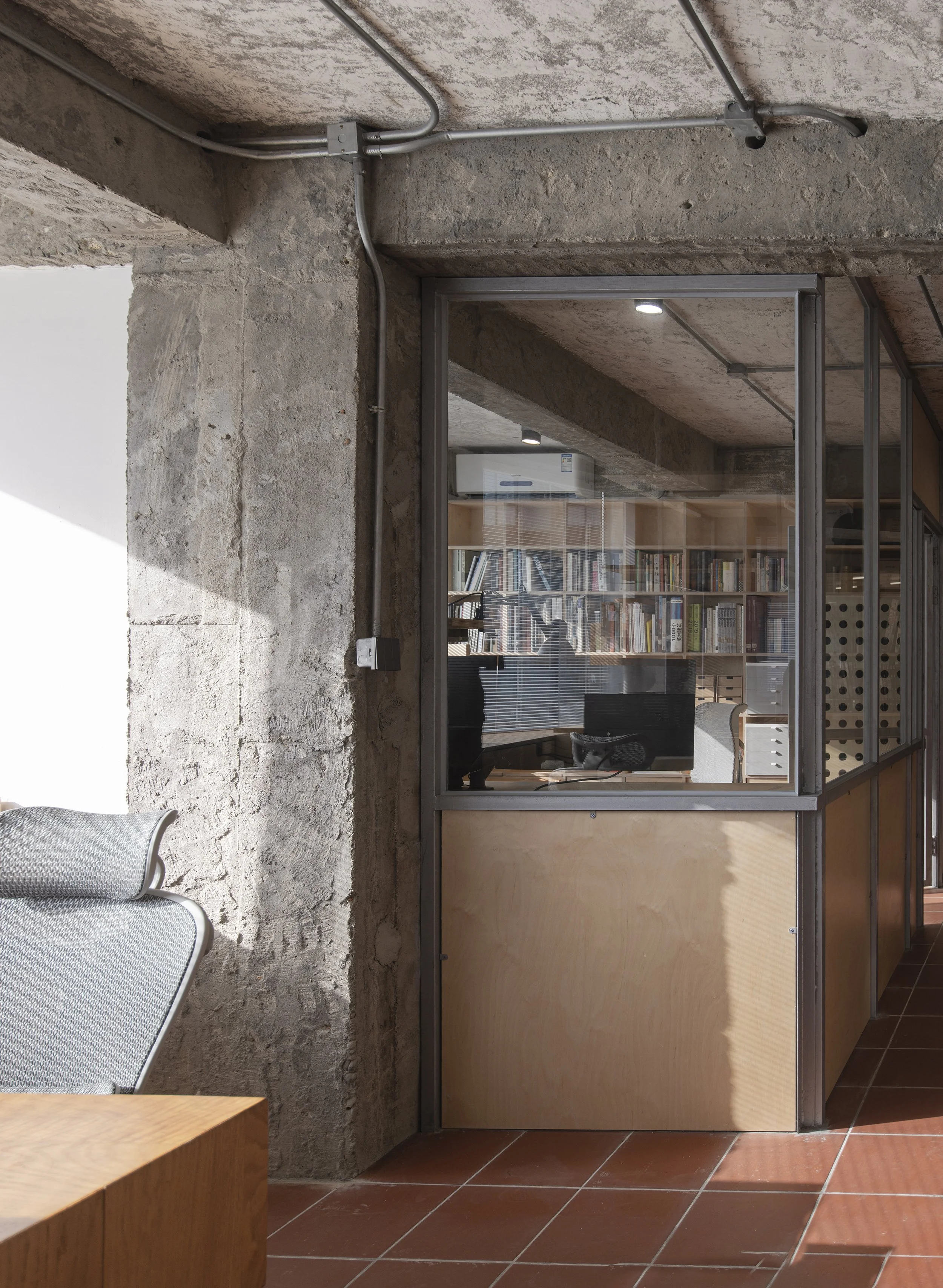
The renovation began by removing the finishing layers from the original concrete frame, exposing the primary structural material as part of the spatial expression.
Newly added concrete elements serve both spatial division and water-related functions. Two cast-in-place exposed concrete volumes were introduced:
Pantry Counter: separating the public and private zones. Its surface is polished into a terrazzo-like finish for durability and ease of cleaning.
Wash Basin Unit: integrating sink, storage surface, and mop basin into a single cast element. The sink shares a drainage pipe with the mop basin, allowing wastewater to be discharged through it. This eliminates the need for complex plumbing beneath the sink, simplifying the visual field and turning functional logic into architectural expression.
03. Concrete
04. Wood: Three Expressions of Joinery
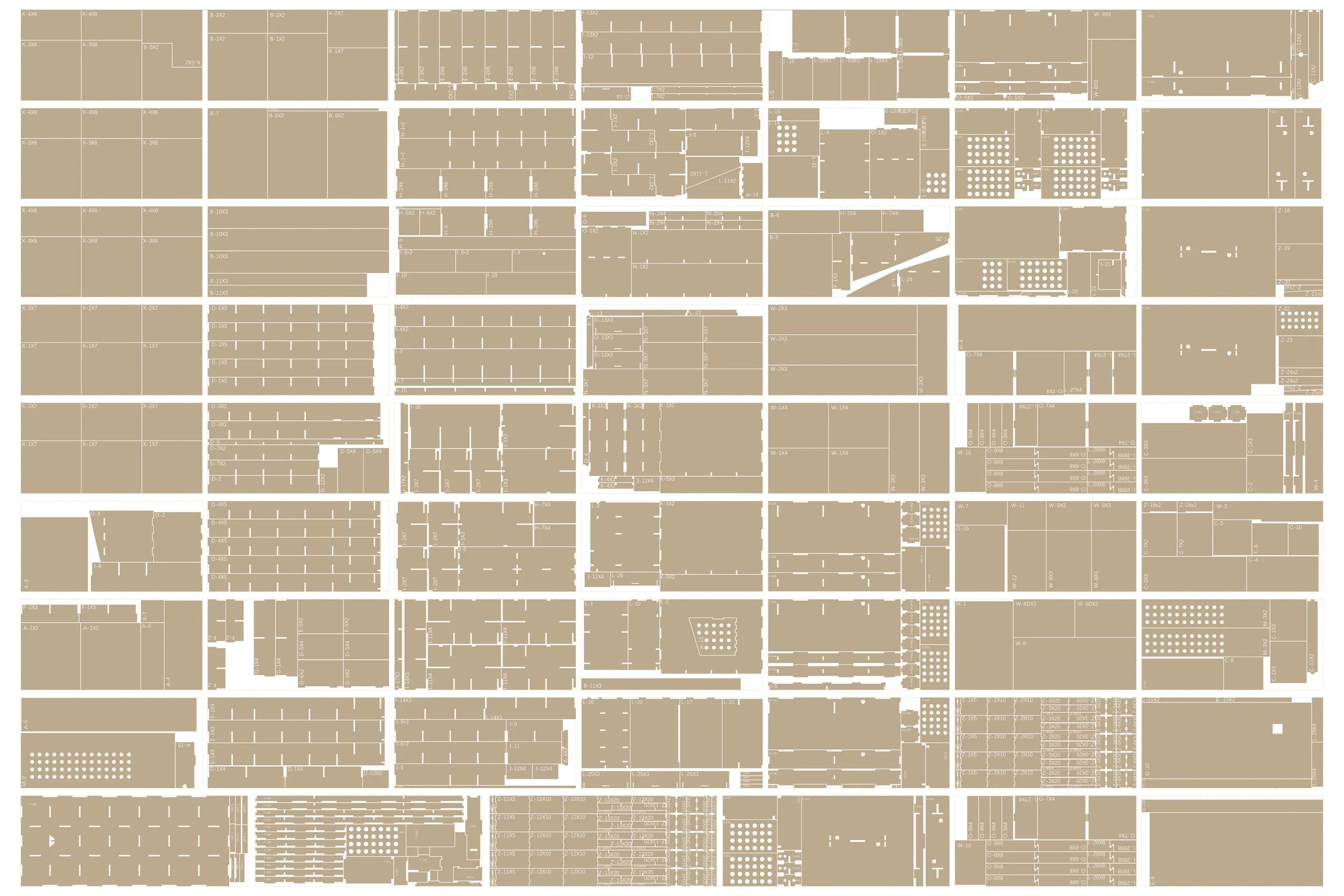
All wooden elements in the office are constructed from birch plywood (marine board), assembled through joinery.The design process unfolded in two interrelated but logically distinct stages:Joinery Design: ensuring all wooden components can be assembled through joinery while fulfilling functional requirements.
Fabrication Design: nesting all joinery components back into standard sheet sizes, and adjusting dimensions accordingly.
In total, the wooden system consists of 782 components fabricated from 62 standard boards, CNC-cut and finished off-site before being assembled on-site.
Traditionally, joinery embodies both structural and aesthetic expression. In this project, we extend it further—as a functional expression.
A wide range of metal materials is used, all adhering to the principle of raw material expression:angle steel frames and municipal steel grating for the entrance door,steel plates for window systems, galvanized steel for desk structures, chrome-plated solid rods (typically used in machinery) for table legs and cabinets.
05. Metal
The entrance door consists of two welded angle-steel frames (top and bottom) as the primary structure. Threaded rods provide diagonal tension to counter long-term deformation. Steel grating panels are bolted within the frames, functioning both as security and structural bracing. An electrochromic glass panel replaces the traditional peephole.
Door
All original windows were removed and replaced with newly designed steel windows tailored to interior functions. The frames use 8mm thick steel plates to maximize transparency. The operable panels are positioned according to interior needs to ensure thermal and spatial comfort.
Window
Furniture is treated as an integral part of construction rather than movable objects. Following the RAW concept, it is developed through two systems: wood joinery and steel structures. Internal-use furniture (desks, discussion tables) uses bolted galvanized steel frames. Public-use furniture (multi-purpose tables, coffee tables) uses stainless steel rods with aluminum joints.
06. RAW Furniture
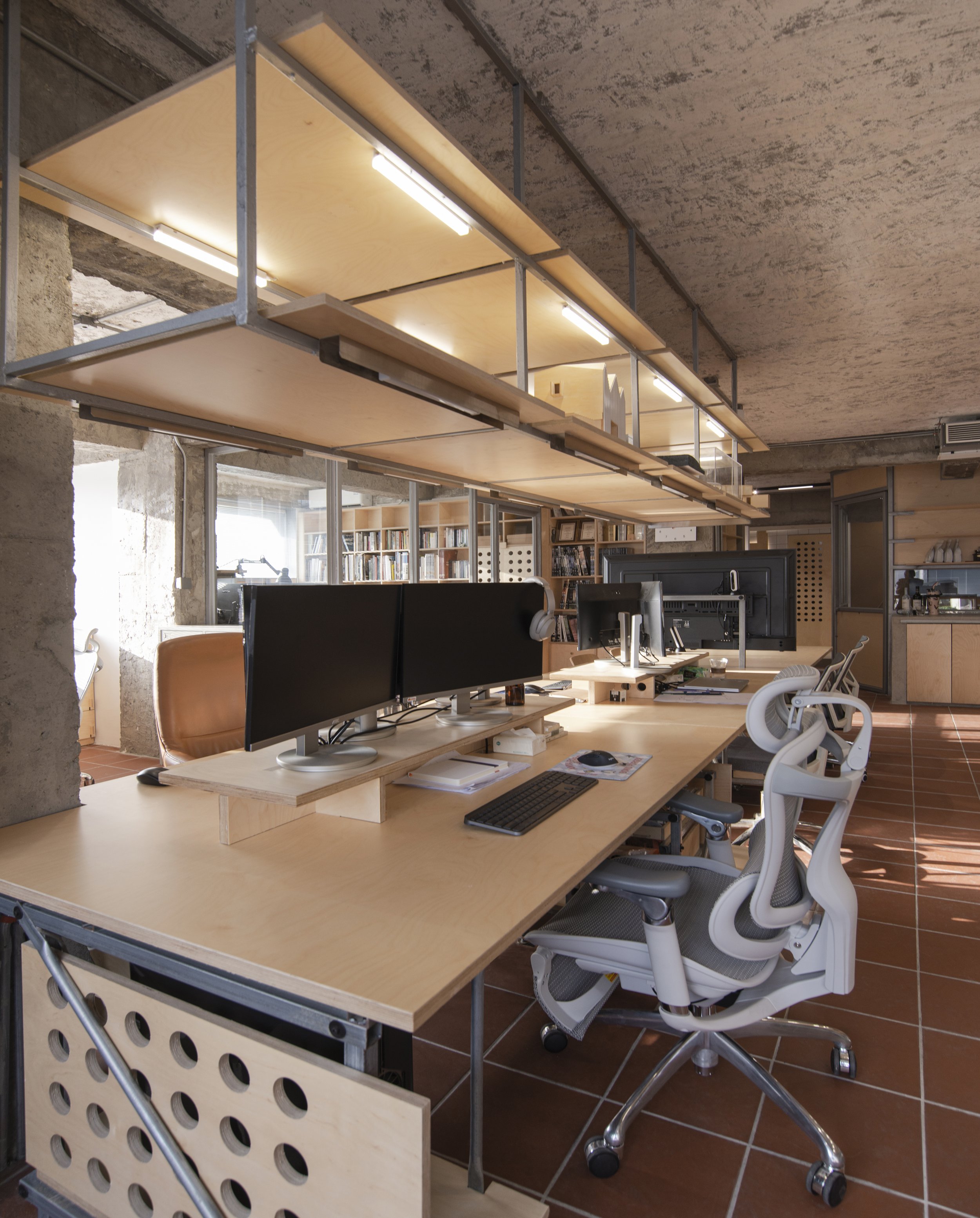
The desk consists of a joinery-assembled wooden top and a bolted galvanized steel frame. Most joints use three-directional bolted hinges, which behave structurally like rigid connections while remaining easy to assemble manually. Where such joints are not feasible, diagonal bracing ensures stability.
Each tabletop is fabricated from a single standard birch plywood sheet (3050 × 1220 mm), cut into joinery components.
Six-Leg Cantilever Desk
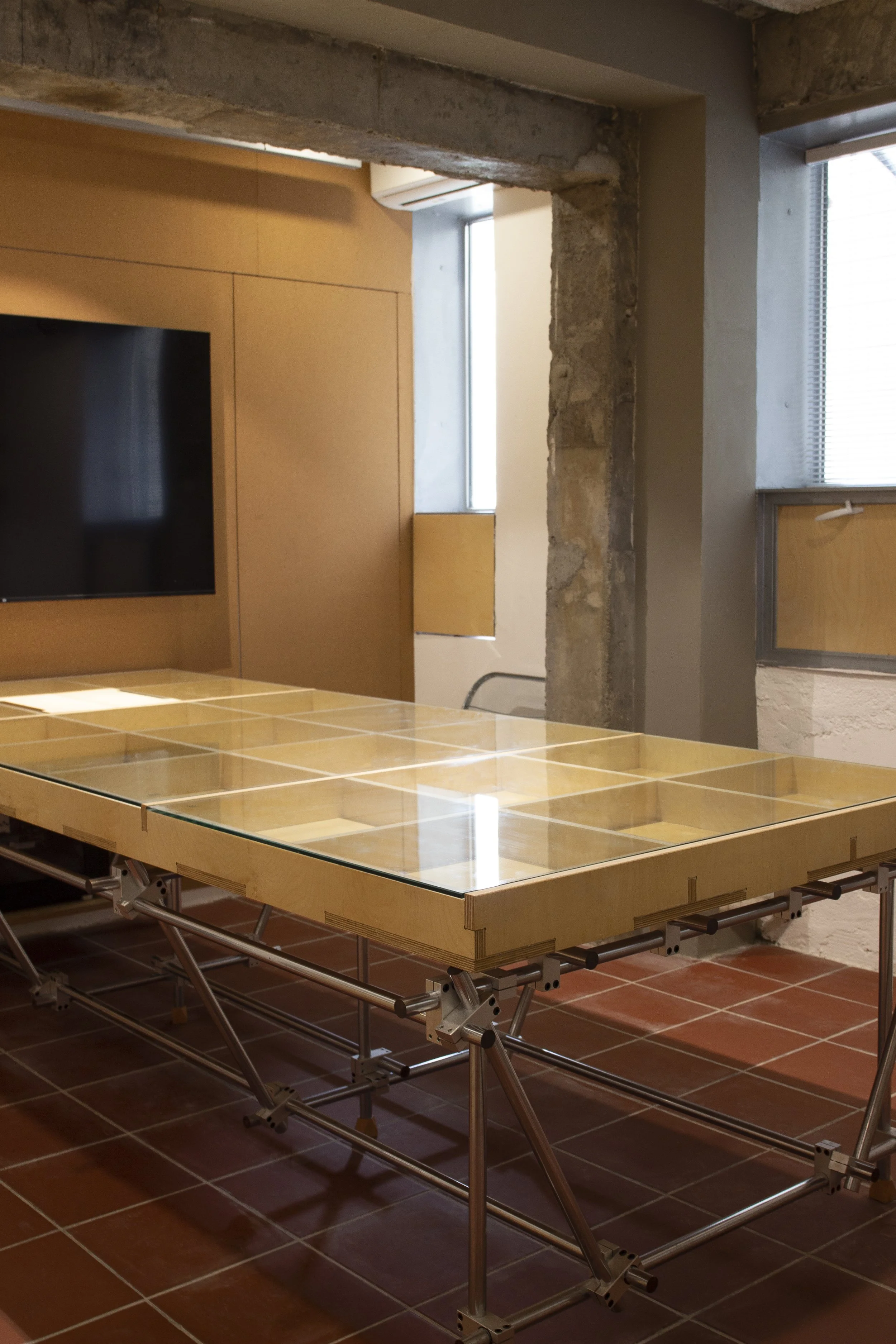
Combining display and meeting functions, the table consists of a joinery-based wooden cabinet above and a stainless-steel rod frame below. The rods form a spatial triangular system, connected entirely by standardized aluminum cross joints.
Multi-functional Table
Cabinets combine steel frames with wooden joinery drawers. The drawers slide directly within gaps sized to match the steel frame, eliminating additional hardware.
Coffee tables follow a similar hybrid logic, using structural interplay between steel and wood to achieve stability and integrated sliding mechanisms.
Storage Units and Coffee Tables