
Bamboo Museum
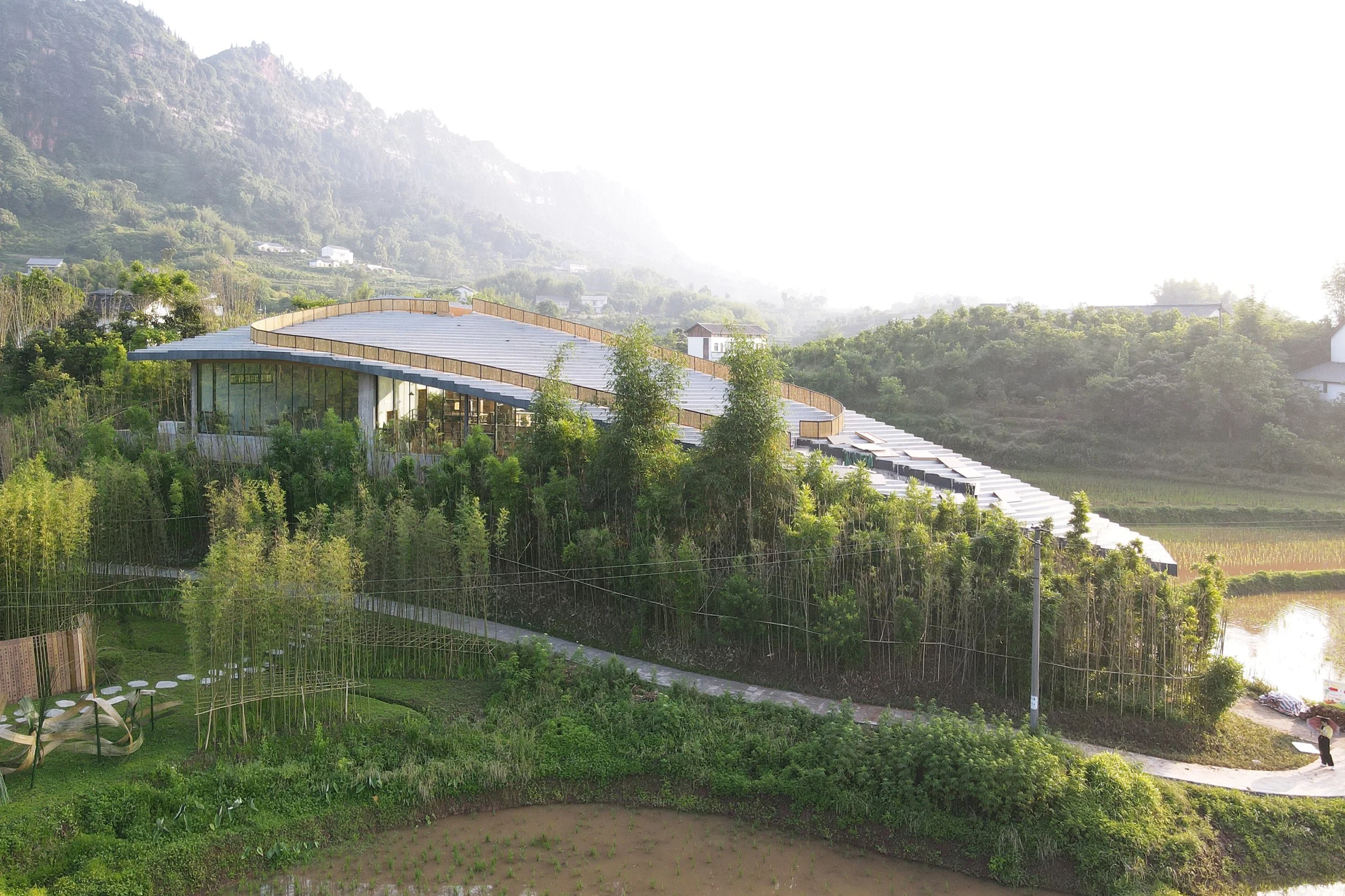
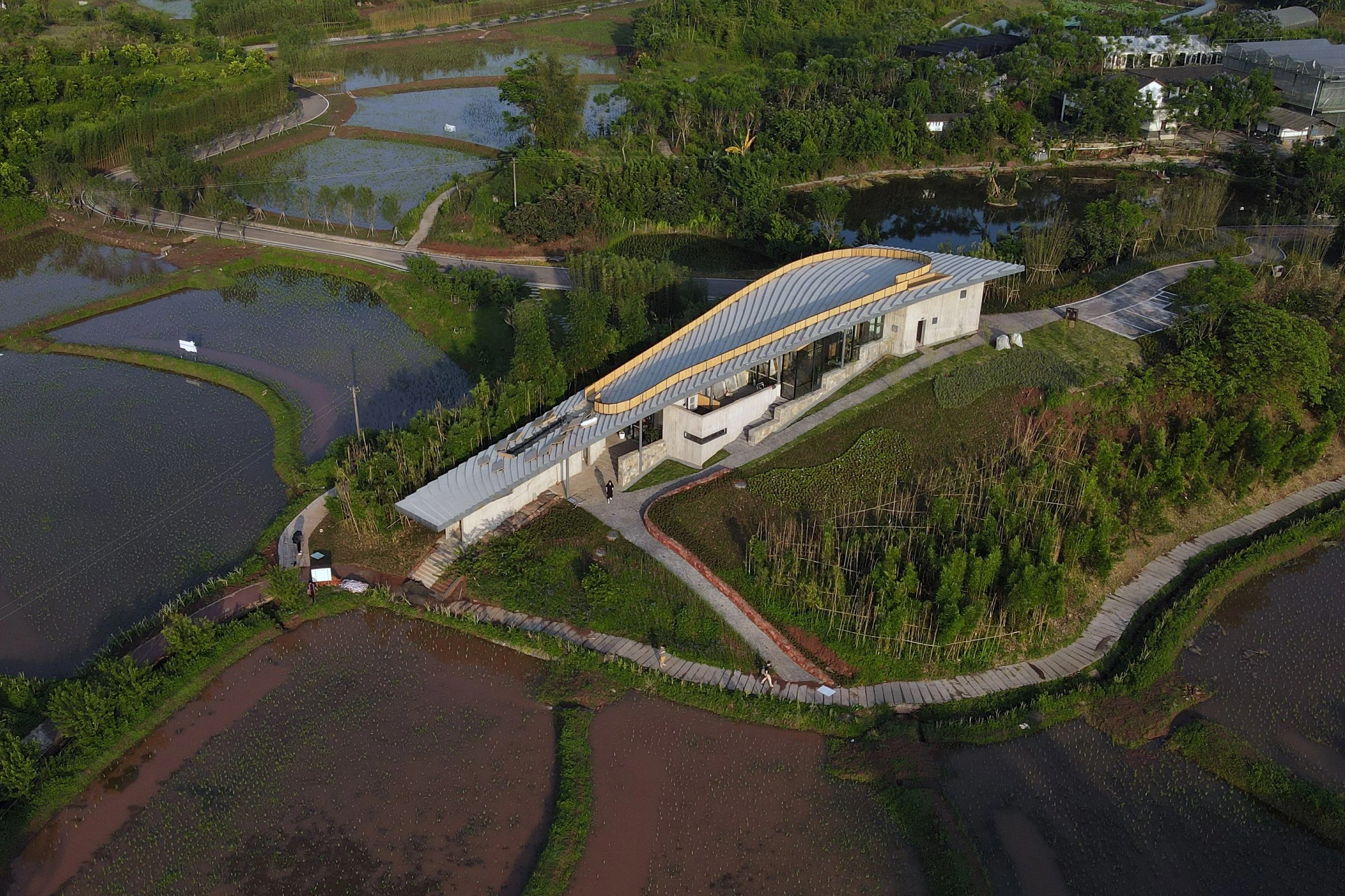
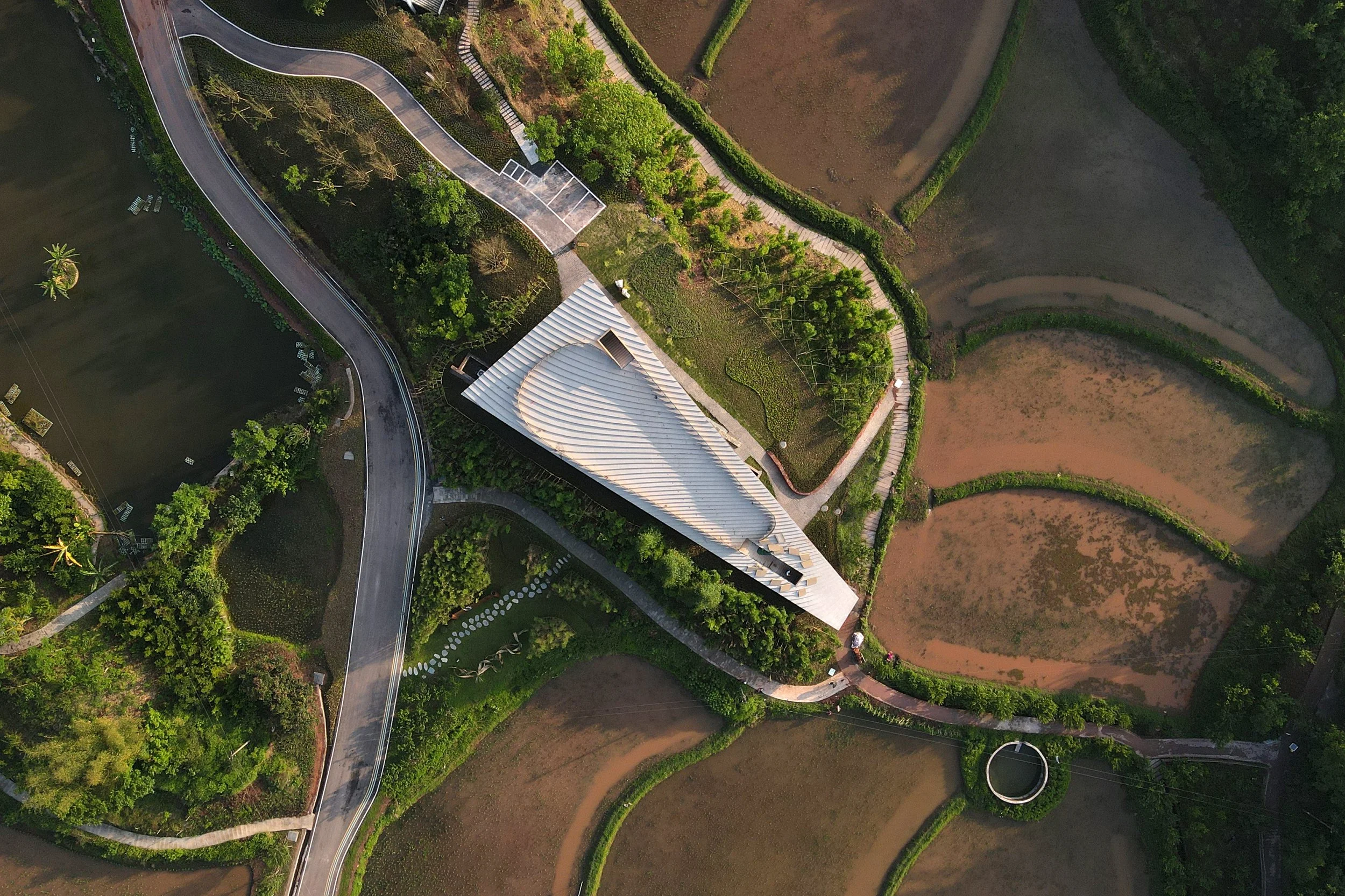
The Bamboo Museum is in Gaoqiao Village, Lizhuang Town, Yibin, on a small hill surrounded by rice fields. The elevation difference from the fields to the top is approximately ten meters. At this scale, the hill is both a site of habitation and the smallest unit of terrain that can be grasped through the body.
Within such a landscape, placing a building at the top would require little justification: it establishes center, visibility, and order. This project refuses that position. Instead of occupying the summit, the building unfolds along one side of the hill, taking up a continuous slope between the foot and the top. This decision does not arise from formal reasoning, but from a more immediate experience: at the scale of a hill, terrain is not understood through overview, but through walking. The summit offers an image, while the path offers a process. What is preserved here is therefore not a point, but an as-yet undefined act of ascent.
The program is defined as exhibition and teaching, yet this distinction is reorganized spatially. The exhibition is not arranged as a series of rooms, but as a path ascending the hill along contour lines. The path rises gradually in a zigzag, with display elements embedded within it, guiding movement while introducing moments of pause and redirection. To enter the building is to enter the act of climbing; to complete the exhibition is to arrive at the higher ground. In parallel, the teaching space is formed directly by the terrain. The stepped classroom is not constructed as an independent form but translated from the existing gradient. Rather than imposing a new order, the building converts the given differences in elevation into a usable interface.
The building occupies part of the hill, while the roof returns this portion to it. This return does not rely on mimicking natural form, but on a more restrained premise: nature itself cannot be directly grasped; what can be grasped are the means by which it is described. In architectural practice, this often takes the form of contour lines—an abstraction that transforms continuous terrain into a measurable sequence.
The roof is constructed accordingly. With a repeated height difference of 150 mm, it forms a continuous stepped surface that can be traversed. It connects two openings at different elevations, linking the rice fields below to the hilltop above. Even when the building is closed, it remains accessible as a public ground. One can enter from the lower opening, ascend across the roof, and reach the top of the hill. In this movement, what is experienced is not simply the terrain itself, but the structure through which it is understood. Each step amplifies the act of ascent, allowing the body to register the hill through the very device that describes it.
When the path and the roof are understood together, the structure of the project becomes legible. The building neither attempts to become part of nature nor stands in opposition to it. Instead, between experience and cognition, it establishes a segment of structure that can be traversed.
Location Yibin city, Sichuan Province
Area 322㎡
Genre museum