兴隆湖儿童艺术中心

Can architecture begin with simple structural rules, and through repetition and intersection generate open functional relationships and continuous spatial experience?

 Although unbuilt, the Children’s Art Center remains significant within this stage of practice because it presented a complete investigation into architectural prototyping. Rather than beginning with programme or form, the project explored whether a spatial system could emerge directly from the internal logic of structure.

The site lies between the city and the lake, with a difference in level of approximately ten metres across an open landscape. Instead of establishing the building as an enclosed object, the proposal separated it into two overlapping systems: a continuous ground plane following the topography and preserving visual and pedestrian continuity between city and waterfront, and a shell structure placed above it, providing an inhabitable spatial framework without interrupting the openness of the site. Because children’s activities are often shaped by movement, pause, climbing and accidental discovery, the interior was not conceived as a sequence of enclosed rooms, but as an open spatial field generated through structure.

The prototype began with a thin unidirectional arch. While a single arch performs efficiently under vertical load, lateral displacement remains its structural weakness. In conventional construction, this usually requires additional mass or heavy boundary conditions to resist horizontal thrust.

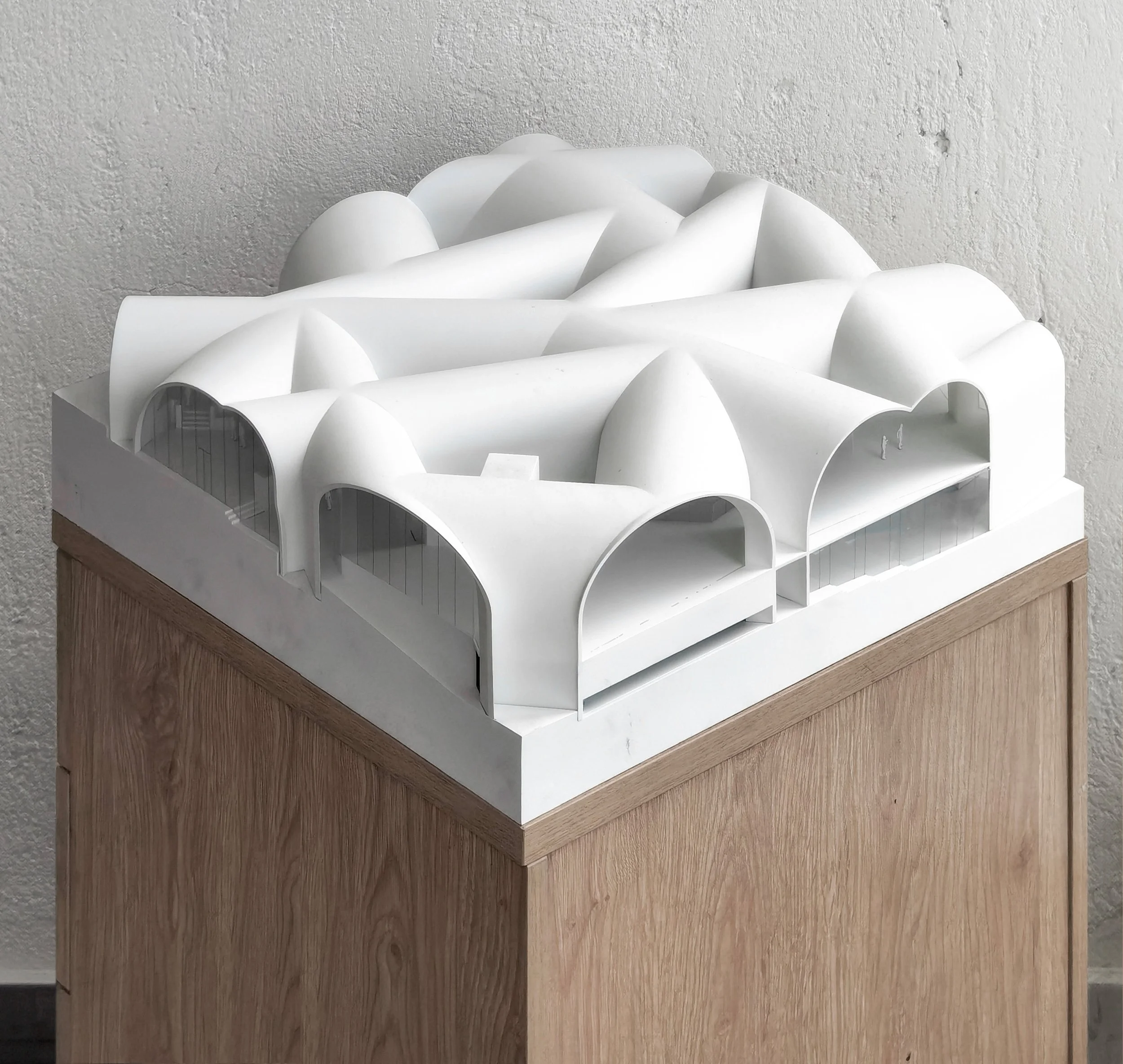
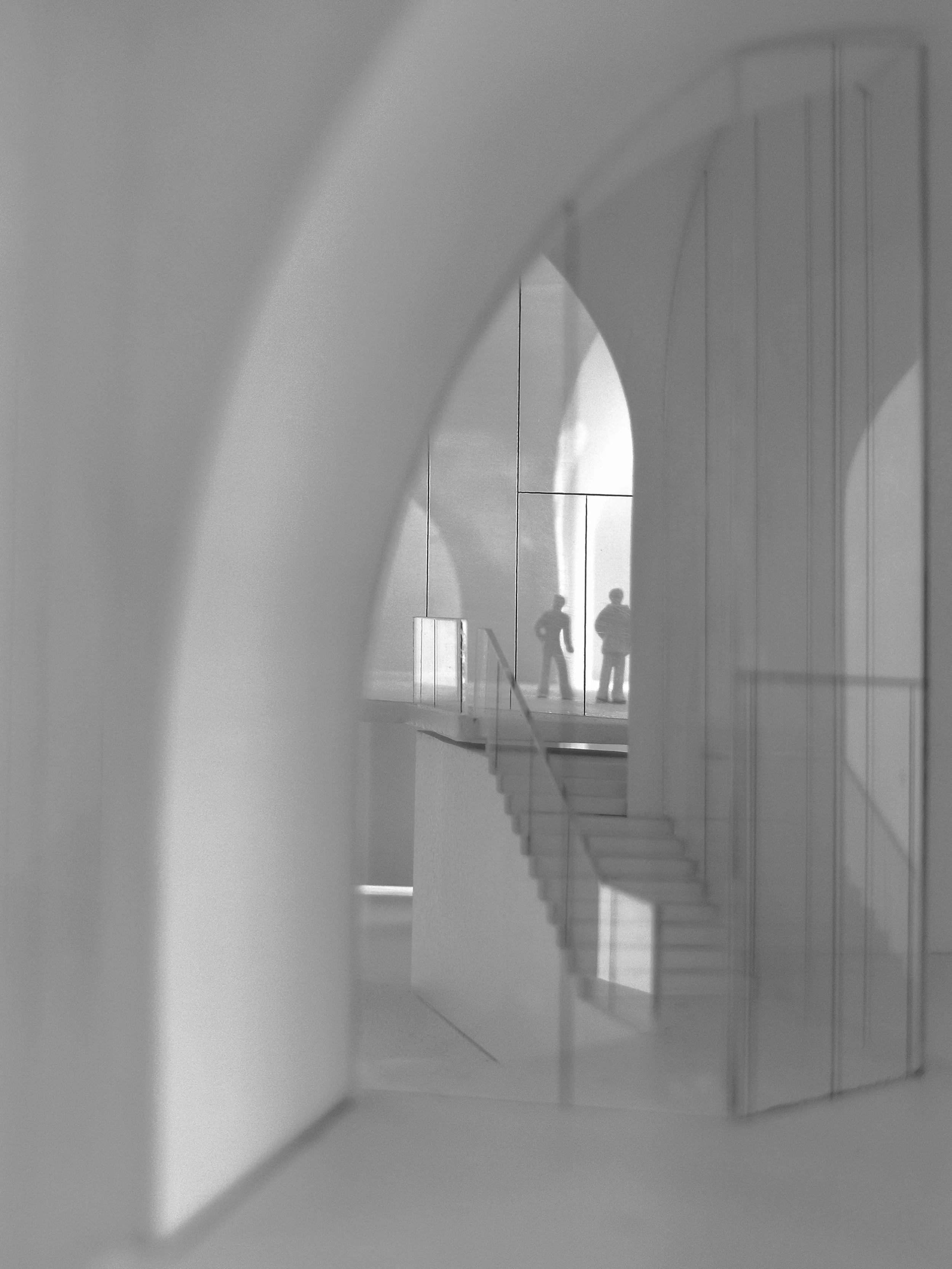
The critical shift came through rethinking how this weakness could be resolved internally. When two arches intersect, the lateral movement of one is stabilised by the longitudinal wall of the other; when three arches interlock, each wall simultaneously becomes part of the stabilising system for the others. Through repetition, intersection and mutual locking, sixteen thin arches formed a continuous structural network.

The prototype was then further refined by subtracting those intersecting portions that carried only local self-weight, removing redundant internal walls while preserving the overall load-bearing logic. This allowed the structure to become a continuous multidirectional shell and released a fully connected interior space.

Structural simulation was used to verify and adjust the prototype, testing wall thickness and refining the relative positions of the arches until structural performance and spatial form reached equilibrium. Calculation therefore did not merely validate the design afterwards, but became part of the generative process itself.

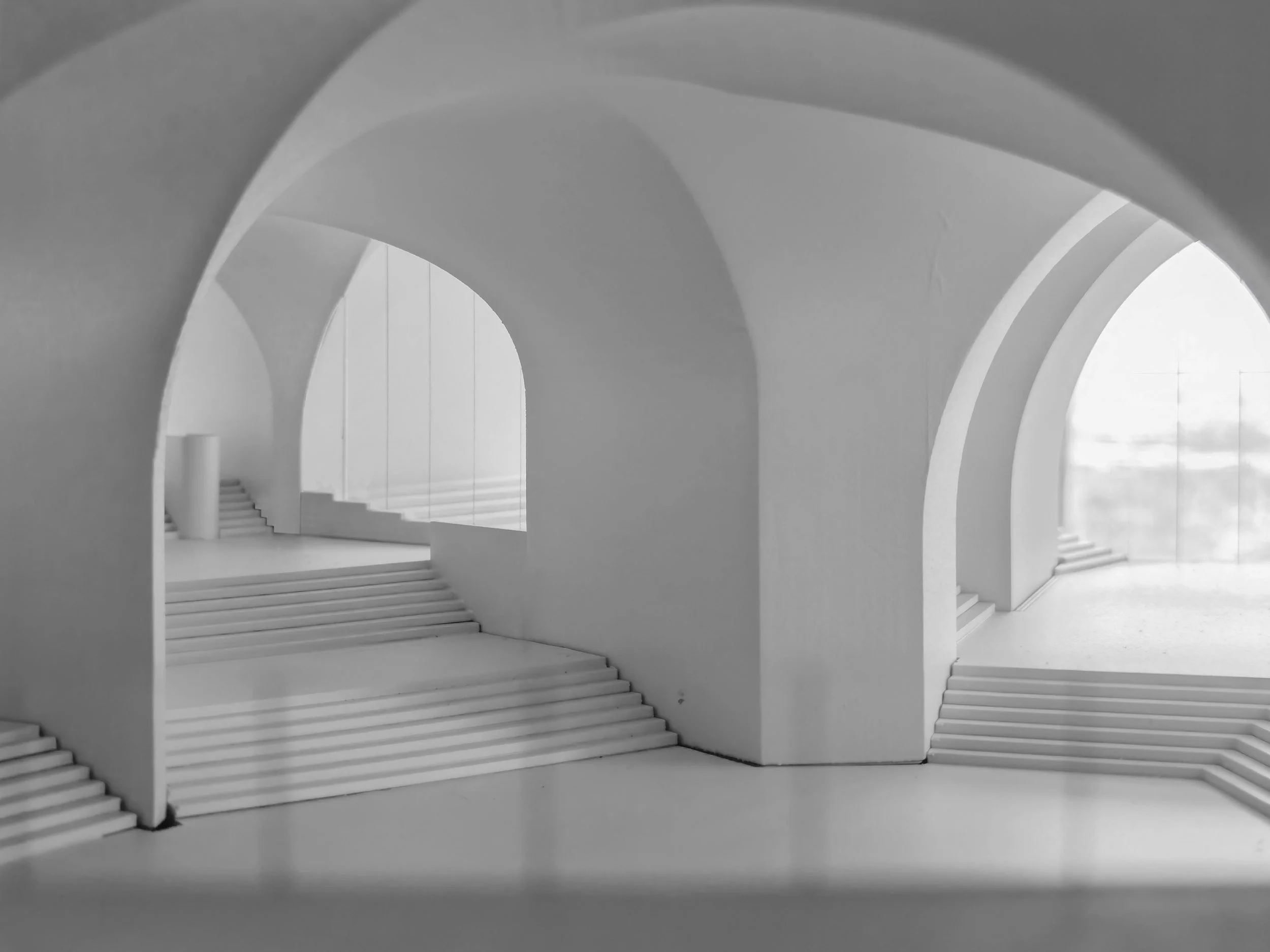
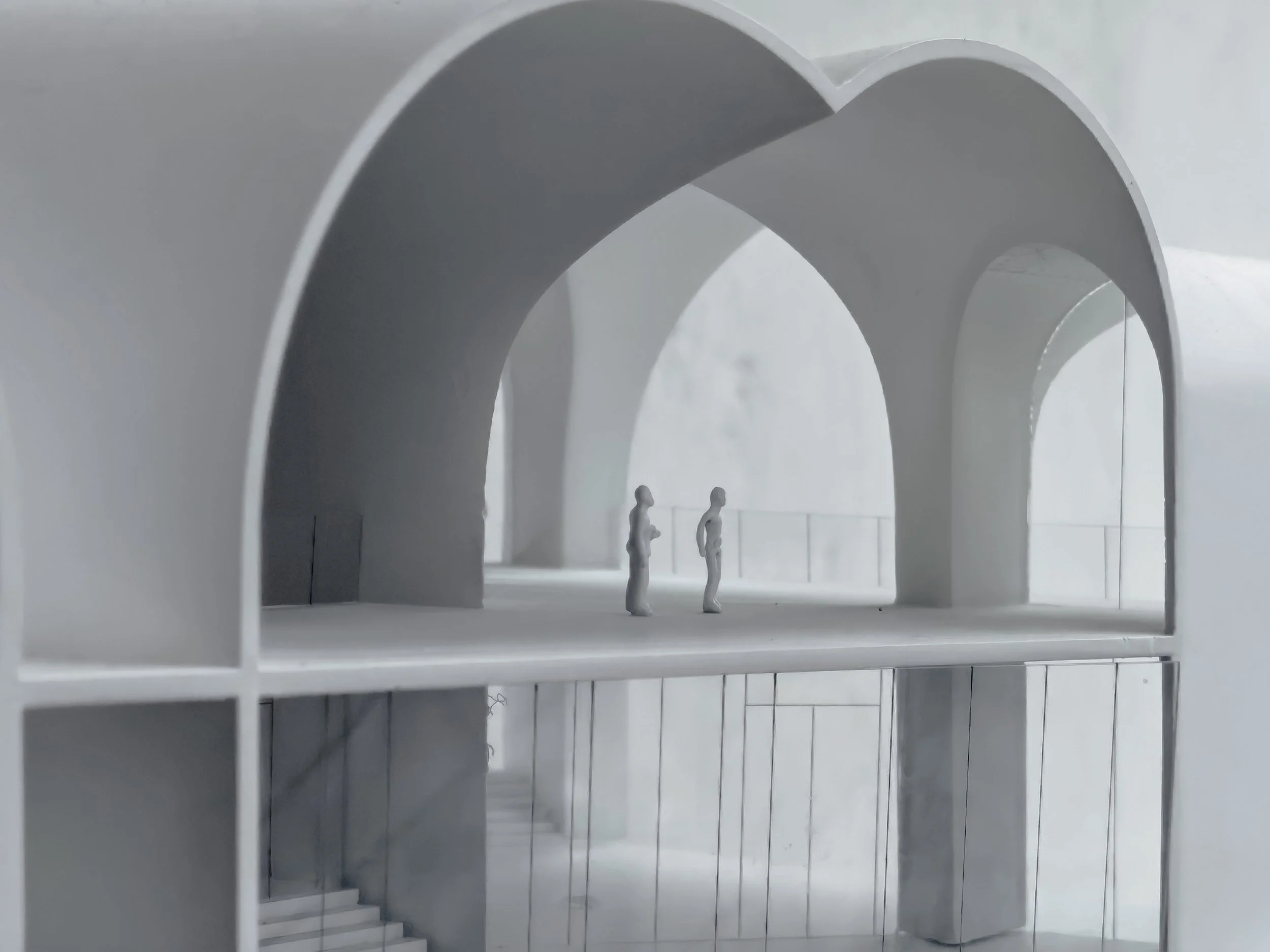
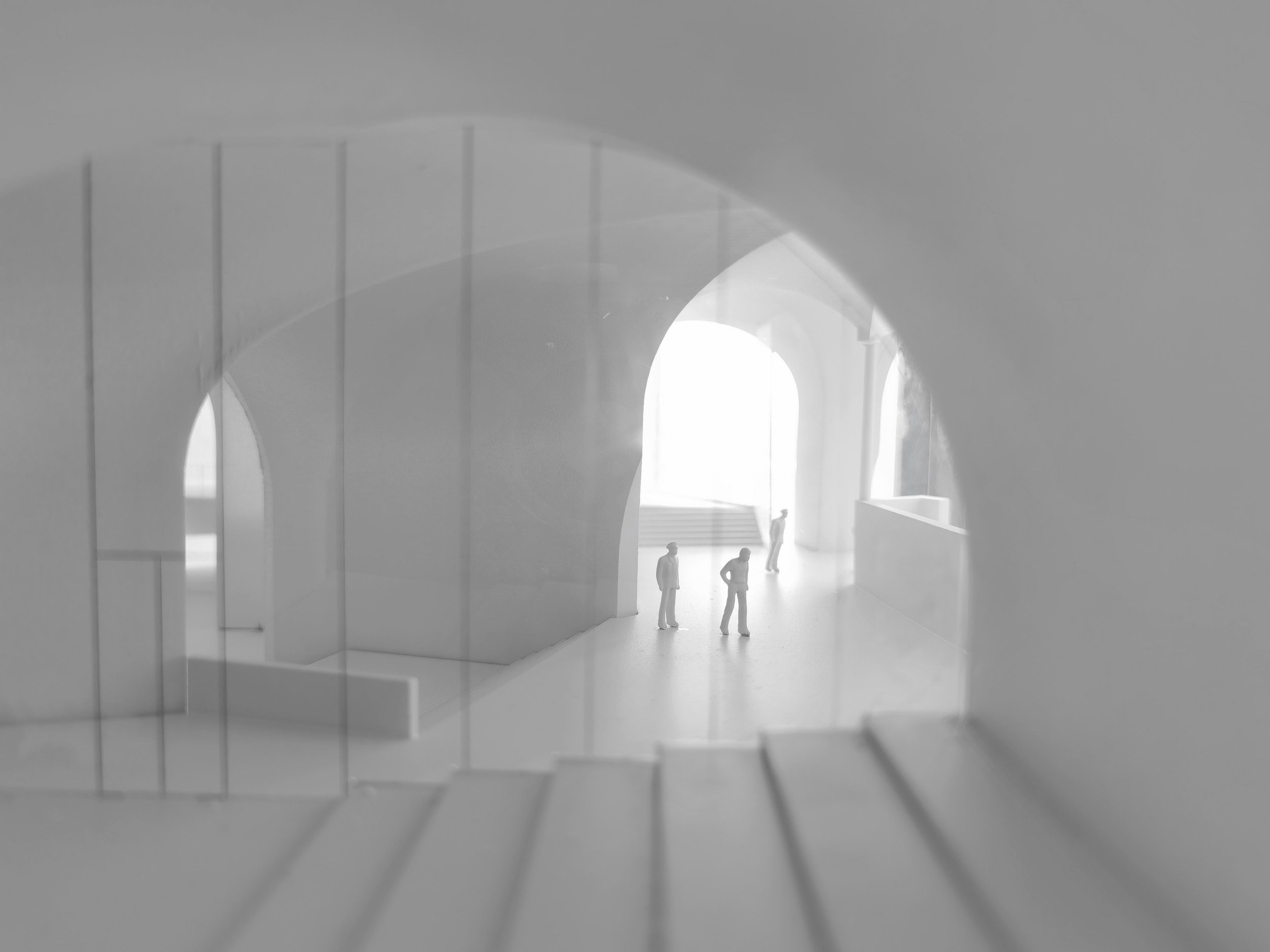
This structural system produced direct spatial consequences. The continuous curved shell dissolved the limitations of a conventional column grid, allowing space to remain open and fluid in multiple directions. Rather than being understood as a collection of separate rooms, the building became a continuous spatial field in which movement, sightlines and occupation were constantly reorganised by structure.

Programme was derived from structural relationships. Arch spans ranged from four to twelve metres, corresponding to different spatial demands: smaller spans accommodated reading and workshops, while larger spans supported exhibitions and public events. Functions overlapped through structural intersections instead of being separated by fixed boundaries. The largest span produced an exhibition hall of approximately twenty-five metres, extending spatially into the landscape and forming a public interior open to multiple interpretations.

As a prototype, the project was not limited to the typology of a children’s art center. Its significance lay in proposing a structural path in which simple rules generate new spatial order through repetition and variation, while form appears only as the visible consequence of that internal logic.

Although never built, the experiment remained open — not as a suspended project, but as a method through which structure could become the starting point for inventing spatial relationships.


项目地点 成都市,四川省

项目规模 1500㎡

项目类型 儿童艺术中心